Orchestra honors 70 years of heritage by launching a season focused on human passion, Chen Nan reports.
By Chen Nan | China Daily
Updated:09:45 AM(GMT+8) July 20, 2026
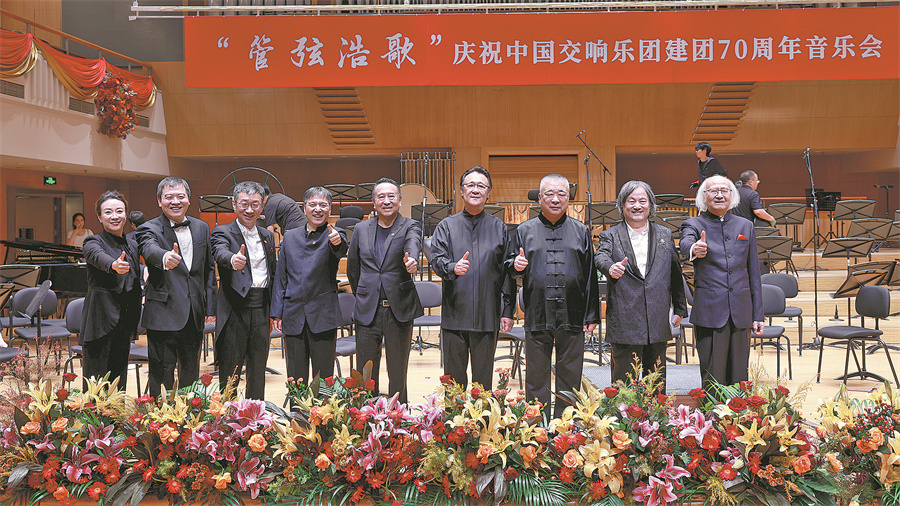
Nine conductors who have collaborated with the China National Symphony Orchestra over the past seven decades reunite on stage during the anniversary concert in Beijing on July 10. [Photo provided to China Daily]
The China National Symphony Orchestra is celebrating its 70th anniversary with more than a milestone season. It is a tribute to an artistic legacy — one passed from generation to generation through conductors, musicians and audiences who have shaped China's symphonic tradition.
On July 11, the orchestra unveiled its 2026-27 season, built around the theme "Love and Death", featuring 20 symphonic concerts, eight choral performances, five chamber music programs and six special projects.
Bringing together leading international conductors and soloists, the season places contemporary Chinese compositions alongside landmark works from the Western classical repertoire.
"We are confronting some of the oldest questions in human experience: love, mortality and the meaning of life in this new season," says conductor Shui Lan, an artistic adviser to the China National Symphony Orchestra.
"From the very beginning, at least 70 percent of classical music has revolved around these two subjects: love and death," he says. "They embody humanity's eternal search for the meaning of life."
The theme shapes 15 of the orchestra's 20 symphonic programs, exploring how composers across centuries have responded to passion, sacrifice, grief and transcendence.
The season opens with a wide historical panorama: Wagner's Tristan und Isolde Prelude and Liebestod examines love carried to its ultimate sacrifice, while Richard Strauss' Death and Transfiguration reflects on spiritual transformation at life's end.
Tchaikovsky's Romeo and Juliet Fantasy Overture and Prokofiev's Romeo and Juliet Suite revisit Shakespeare's timeless tragedy alongside Mendelssohn's A Midsummer Night's Dream and Vaughan Williams' The Merchant of Venice, marking the 410th anniversary of Shakespeare's death.
The repertoire also spans the 20th and 21st centuries with works including Arnold Schoenberg's Transfigured Night, Rachmaninoff's The Isle of the Dead, Modest Mussorgsky's Songs and Dances of Death and Tchaikovsky's Francesca da Rimini. Opera and ballet will also feature prominently, including a concert performance of Puccini's Tosca, Rodion Shchedrin's Carmen Suite, Igor Stravinsky's The Firebird and Ravel's Bolero.
Shui says the season has been designed around stories rather than famous titles. "Every concert tells a story," he says. "We hope audiences leave not only appreciating the music but also discovering the connections between different cultures."
One of the most anticipated highlights of the season is the newly commissioned violin concerto The Essence of Love by renowned composer Chen Yi. The work, which will be performed on June 13, 2027, by the China National Symphony Orchestra under Shui's baton, will make its world premiere during the season.
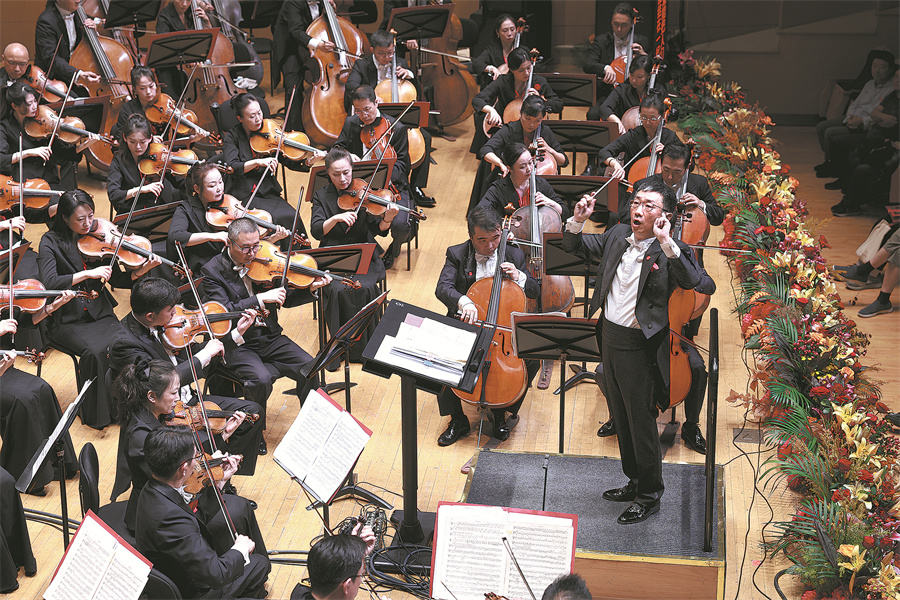
Conductor Li Xincao leads the China National Symphony Orchestra during its 70th anniversary concert at Beijing Concert Hall on July 10. [Photo provided to China Daily]
"After losing her brother, violinist Chen Yun, in 2024, Chen Yi spent two years writing this work," Shui says. "Through music, it explores three dimensions of love — love for family, artistic devotion and humanity — offering a deeply personal response to the season's central theme."
On March 7, 2027, conductor David Hoose will lead the male chorus of the China National Symphony Orchestra to perform Neruda Songs, a cycle of five songs composed by the American composer Peter Lieberson (1946–2011) for his wife, singer Lorraine Hunt Lieberson (1954–2006). J'Nai Bridges, a three-time Grammy Award-winning American mezzo-soprano, will perform in the concert.
The season also commemorates major composer anniversaries, including the 270th anniversary of Mozart's birth and the 120th anniversary of Shostakovich's birth, with performances of Mozart's Jupiter Symphony and Shostakovich's Symphony No 6 and Cello Concerto No 2.
Chinese symphonic music remains at the heart of the season.
The orchestra will present more than 10 works by Chinese composers and Chinese-born artists including Guan Xia's Earth Requiem, excerpts from Chen Musheng's Symphonic Peony Pavilion — Heaven, and the Chinese premiere of Zhou Tian's A Thousand Years of Good Prayers.
It will also premiere a new choral cycle inspired by Dawn Blossoms Plucked at Dusk, the writings of Lu Xun, marking the 145th anniversary of the writer's birth and highlighting the orchestra's growing interest in literary and dramatic storytelling through choral music.
International touring will form another major chapter of the anniversary season. In September, the orchestra's chamber ensemble will tour Canada, performing in Vancouver, Toronto, Ottawa and Montreal with programs featuring works by Edvard Grieg and Tchaikovsky alongside Chinese compositions.
From November to December, the full orchestra will present anniversary concerts in Hong Kong and Macao.
In February 2027, the orchestra will head to Vietnam for two concerts conducted by resident conductor Jing Huan, joined by Vietnamese soloists. The programs will bring together masterpieces by Paganini, Tchaikovsky and Stravinsky with Chinese and Vietnamese works, celebrating cultural friendship through music.
The China National Symphony Orchestra was established in 1956 and has a long history of performing classic Chinese music, championing patriotic pieces written during wartime, such as Yellow River Cantata by Xian Xinghai (1905-1945).
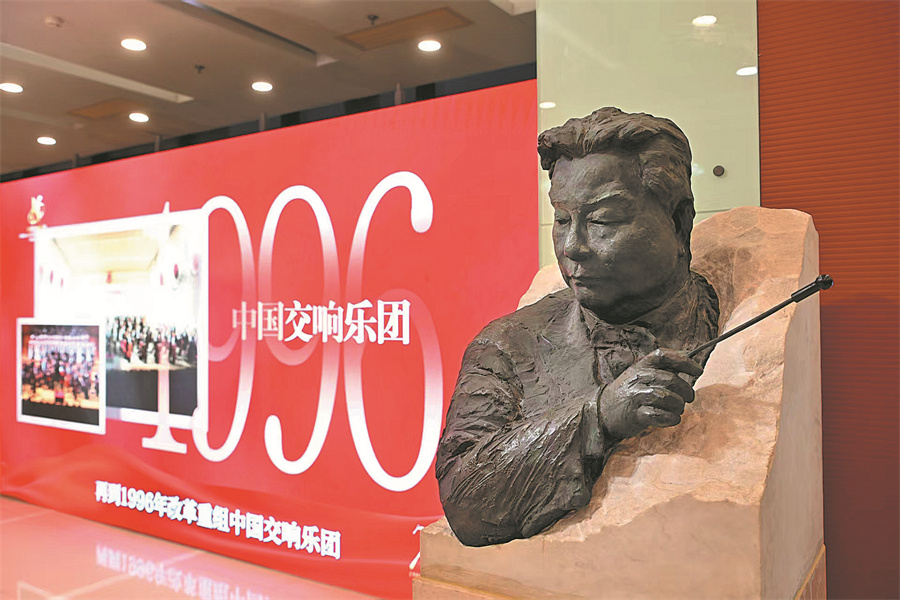
An exhibition featuring a sculpture of the late conductor Li Delun (1917-2001) is ongoing at Beijing Concert Hall as part of celebrations marking the China National Symphony Orchestra's 70th anniversary. [Photo provided to China Daily]
The season launch followed the orchestra's 70th anniversary gala at Beijing Concert Hall on July 10, an emotional reunion of musicians who have shaped the ensemble across generations.
Nine conductors with deep connections to the orchestra, including Tang Muhai, Tan Lihua, Hu Yongyan, Chen Xieyang, Li Xincao and Shui, performed at the concert with the orchestra.
For conductor Li Xincao, the anniversary was not only a milestone for the institution, but a reflection of his own artistic journey.
"From the days when I was a young student looking up at the stage of the China National Symphony Orchestra (formerly known as the Central Philharmonic Society), to the years when I have conducted the China National Symphony Orchestra and stood alongside its musicians through countless seasons and international tours, my connection with this orchestra has accompanied my entire artistic life," Li says. "It has long been inseparable from who I am."
Li's relationship with the orchestra is also tied to one of its most important traditions of artistic inheritance. Recalling the moment when Li Jue, the widow of cofounding member and conductor Li Delun (1917-2001), handed him the legendary conductor's baton, he says: "At that moment, I felt I was receiving not only a baton, but the responsibility, artistic lineage and ideals passed down by generations of musicians of the orchestra."
To Li Xincao, the well-worn baton symbolizes the orchestra's enduring spirit — a reminder that conducting is ultimately about human connection, not technical display.
For the orchestra's leadership, the anniversary is less about looking back than moving forward.
"Seventy is still young," says Zhou Yu, secretary of the orchestra's Party committee. "We cannot simply live on past achievements. We must carry forward the traditions of our predecessors, renew ourselves and begin the next chapter."
He believes orchestral music has an even greater role to play in an age increasingly shaped by artificial intelligence.
"AI can replace many kinds of work," Zhou says. "But humanity and the kind of reflection on life that reaches directly to the heart can never be replaced by machines."



 京公网安备 11010502034423号